NEW SITE ANNOUNCEMENT

Welcome! Before you get comfortable - I have moved! Please come over to my new place, Do What You Love http://www.dowhatyouloveforlife.com/

Showing posts with label Do What You Love interview. Show all posts

Wednesday, 22 December 2010

Do What You Love interview: Rachael Taylor


Voted ‘Happiest Person in Britain’, this really is a girl doing what she loves. Rachael Taylor’s bright and fun designs caught my eye some time ago, and I bought an original piece of her work for my studio. As a surface pattern designer and illustrator, Rachel has clients all over the world, and next year she will be bringing out her own line of stationery with US-based Teneues publishing.

(image courtesy of Rachael Taylor)

Rachel graduated in 2005 with a BA (Hons) in Textile in Fashion Design. After working in industry for three years, she set up her own design studio in 2008. Now specialising in surface pattern design and illustration, Rachel works as a freelance designer for clients like WH Smith, Target and Graham and Brown, and runs her own design label, Rachael Taylor Designs. Rachel’s international collaborations include a signature collection with Seascape Lamps USA. I talked to Rachel about loosening up, setting up on her own and getting known.

(image courtesy of Rachael Taylor)

1. For those new to ‘surface pattern design’ can you explain what it involves?
Working as a surface designer is great fun and never dull.  Surface pattern covers so many areas and products in the market, so my work is very varied and every day is a new challenge. I've designed for magazine covers, greeting cards, packaging, fashion and homewares, so it keeps me on my toes.
If I'm working for a client on a freelance commission I tend to work from a direct brief but if I'm designing for my own label, I try not to have a plan. I just let my designs and ideas flow naturally. I also create surface designs and illustration that I license out to companies.  They tend to use them exactly as they are but sometimes I re-colour them to tie in with their collections.


2. How would you describe your signature style and how did it come about?
I'd say my signature style is free, quirky & spontaneous.  It normally involves elements of freehand drawing, bright accent colours, textures and layering. Sometimes I combine all of these things together. I think it stems from my student days. I studied Textile and Fashion design at Leeds but our tutors were really keen on mark-making, drawing, painting and working more freely.
My portfolio was more fine art based rather than your typical design portfolio. It took me ages to loosen up my work, then in my final year whilst creating my screen printed collection something just clicked and it all fell into place. That's when I started to really have fun with it and take risks. I'm never afraid to experiment as quite often my mistakes turn out to be my best pieces.

(image courtesy of Rachael Taylor)
3. You have had great success getting your work out across the country and internationally. Can you talk us through the steps of getting one of your designs into a shop as a product?
I think a few factors helped in getting my own label out. I work as a freelance designer for other companies in the UK, USA & Europe so I think that raised my profile and people were aware of my style already. Being featured in books and magazines and on blogs really helped too, as people became more aware of me. When I first started my own line (launched in Sept 2009) I just started very small. I opened a notonthehighstreet store, and planned to just planned to sell online. Then when I started to see there was interest in it. I decided to approach a few local shops and it just went from there really. I rang up the British Craft Trade Fair about exhibiting at their 2011 show and they said someone had pulled out the 2010 show. There was just one week to go before the show so they offered me discounted space. It was a crazy idea and at first I said no, as I thought I couldn't pull it off. But then something clicked and I just thought “I'm going to take the risk and go for it”. It paid off - this really got me out there and now I have number of stockists in the UK.

4. What made you take the leap from working for someone else to setting up your own design studio?I just decided it would be nice to have a few small things that I could call my own and put my name to. Then from I decided to have a signature range that I'd license out with my name on as a brand. It's really nice having the freelance and my own stuff - I feel very lucky that I have the best of both worlds.  It can be crazy, non-stop juggling sometimes, but that's what I love. I wouldn't have it any other way!

5. What were the biggest challenges you had to overcome in setting it up?
I've found it hard managing the admin side of things - there are just never enough hours in the day. I've had to become quite business-minded so that's been a learning curve too! I find it hard that some days the business things eat away into my creative time.  I've had a fair few time delays with product development too, which has been a bit stressful. More recently I had a designer blatantly copy my work too, so that was an awful situation to deal with.

(image courtesy of Rachael Taylor)
 
6. What do you wish you had known when you were starting out?
I wish there was a guide to prepare you for setbacks you may have, every day I learn something new! I never knew I'd have to become so business savvy that would have scared me off!

7. How much of a role does technology play in your business? (in terms of actually creating your designs, managing your business, promoting yourself etc)
Technology plays a huge part. I create my designs on my mac using a graphic tablet. I still use traditional methods but everything has to be developed on the computer in the end. I use twitter, my blog, my website, facebook to promote my work on the internet. It really does work – I have had a fair few overseas clients find me via twitter!

8. What makes you ‘the happiest person in Britain’?
That was a bit bizarre receiving that title,but wonderful too! I feel very honoured. I'm just a regular girl who rambles on a bit. I think I'm quite an upbeat and positive person. My tweets (on Twitter) come across that way. I'm just so grateful that people have received my work really well, so I think that shows as it makes me really enjoy what I do even more. Little things keep me happy like my family, great friends, my lovely dog, music… I love music! My work is really influenced by it as pieces are created depending what mood I'm in. My work keeps me happy, I'm extremely passionate about what I do.

9. Where will you take your business next?
I'm hoping to continue expanding my own line and develop further homewares products. I also want to continue freelancing as I think it keeps my work fresh and I love working with new products and challenges. I've also started receiving regular bookings in schools and colleges for workshops and talks. I want to continue with that too as I really love doing it.
 You can see Rachel’s lovely designs on her website and blog, or connect with her on Twitter or Facebook.


***


(image courtesy of Rachael Taylor)

Thursday, 16 December 2010

Do What You Love interview: Mark McGuinness


Rain falls with twilight –
the city’s fingers drumming
on our umbrella

***
Rain haiku by poet and creative coach Mark McGuinness
(Image courtesy of Mark McGuinness)


This Do What You Love interview features Mark McGuinness, a poet, creative coach and trainer and creative entrepreneur. He has been coaching artists and creatives since 1996, when he noticed a high proportion of them turning up in his psychotherapy consulting room. He has also consulted for organisations including the BBC, Channel 4, Arts and Business, the Institute for Practitioners in Advertising (UK) and many creative agencies and studios. Since 2006 he has been blogging about creativity and business at Wishful Thinking. In 2008 he launched Lateral Action  with Brian Clark and Tony Clark, developing the site as a resource for creative entrepreneurs - first a blog and later the Lateral Action Entrepreneur Roadmap.  . Mark's latest course is the Creative Pathfinder, a free 25-week guide to success as a creative professional.  I caught up with Mark to find out what gems he could share from his many years of working with creatives (and find out a bit about poetry too).


- Can you remember the first time you referred to yourself as a poet?  What made you do that for the first time?
I can't remember, to be honest. Robert Graves said 'poet' is a courtesy title - there are very few real poets, the ones with the genuine magic in their words. On the other hand, the original meaning of the word 'poet' is simply 'maker', so maybe it's just the equivalent of the modern 'creative'.


- Do you see life differently as a poet?
Wow that's a big question. I think that what we call poetry is something inherent in life, which we can all see, if we look carefully, or sometimes it catches us off-guard and we can't help seeing it. Poets make a habit of looking out for it, and trying to capture it in words, but every true artist is after the same thing. And having spent a little time with Buddhist monks, I think they are on the lookout for the same thing, they're just not so worried about capturing it!


- You are also a coach for people in the creative industries. Why is coaching important for artists?
Coaching allows me to work one-to-one with creatives, so I can take account of their individual - often idiosyncratic - talent. There's no one-size-fits-all when it comes to creativity - what works for one person won't work for another, and sometimes the hardest part is recognising where your own inspiration is leading you. I often hear from clients that one of the biggest benefits they get from coaching is simply validation of who they are and how they do things, as they sometimes go through life feeling like a square peg in a round hole.


- How did Lateral Action come about and what kind of impact has it had?
It came about through discussions between Brian Clark, Tony Clark and me. Towards the end of 2007 I released an ebook titled Time Management for Creative People - little did I know Brian and Tony were thinking about launching a site about creativity and productivity, so when I sent it to them, they said it was 'bang on target' and the conversation went from there.
In terms of the impact... well I'm maybe not the one to judge, but we've had a terrific response, both to the blog, the Entrepreneur Roadmap, and now the Creative Pathfinder. Every week I hear from people who tell me it has helped them in their creative work, their career, or their business, so it feels like I'm making some difference, but there's always plenty more to do...


- What question are you asked most often by your consulting clients, and how do you respond?
I can't really narrow it down to one question. Maybe four:
1. How can I find a way to do my real creative work, in the midst of interruptions (from the outside) and distractions (from the inside)?
2. How can I get others to notice my work (and buy it)?
3. How can I deal with person X, who's in my working life and not at all easy to work with?
4. How can I motivate myself to keep going, in spite of rejections, criticisms, disappointments and the rest of it?


I generally respond by doing a lot of listening and asking questions - first to clarify the situation, and then to unlock their own ideas about how they could approach the situation differently. Sometimes I'll also 'put in' some ideas and advice around specialist topics, e.g. productivity systems, stress management techniques, internet marketing strategies. Either way, the idea is to get clients to be able to learn new approaches for themselves, that they can put into practice in future.


- What is the best thing about working with creatives?Partly it's inspiring to be around interesting, creative people doing amazing work. And partly because I'm a creative myself, so I feel an affinity with them. It's a tribal thing. :-)


- When you get stuck in your own creative endeavours nowadays, do you deal with yourself as you would a client, or do you turn to others for support?
Sometimes I can get myself unstuck, having seen most of the usual pitfalls in myself and others over the years. I don't necessarily deal with myself as I would a client, but hopefully there's an occasional flicker of self-awareness that comes into play! And sometimes I work with a coach, or a teacher who knows a lot more than me about what I'm trying to do. Mimi Khalvati at the Poetry School is a particular source of inspiration.


- What is the next big dream for your business?
I'm really excited about several new products I have in the pipeline that will be released over the next year or so. Plus I'd like to travel more, so I'm working to move as much of my business online as possible. E.g. I'm doing more and more e-learning and coaching via Skype, as well as live workshops and face-to-face sessions.


***


You can find Mark on his Wishful Thinking blog, on his poetry blog, or for bite-sized inspiration you can follow him on Twitter


***


See here for more interviews with inspiring people doing what they love


***

Are you an artist wanting to make more money from your talent?  Are you a budding creative entrepreneur?  Have you heard about the Do What You Love art and creative enterprise retreat, to be held in a stunning countryside venue in England next May?  Sign up for the newsletter (on the right) to be the first to hear when registration opens!

Friday, 10 December 2010

Do What You Love interview: Abigail Borg

Multi award winning young surface pattern designer and illustrator Abigail Borg is riding high, having just been awarded 'Best British Pattern Design 2010' by Elle Decoration at The British Design Awards.

(image courtesy of Abigail Borg)

Just two years since winning New Designer of the Year 2008 award for her collection of hand-drawn and digitally-printed wallpapers, Abigail’s wallpapers, cushions and fabrics are now stocked in Liberty of London and in stores across the world. She also has freelance illustration clients like Laura Ashley Home. I talked to Abigail about her phenomenal success, and how she is managing her rapidly growing creative business.

(images courtesy of Abigail Borg)

Ever since you graduated from Leeds College of Art your feet haven’t touched the ground – what has been the most exciting thing about your journey so far?  I think just being able to do what you want to do, and feeling happy with that is the most exciting thing. No restrictions, trends to adhere to, colour palette to work with. If what I design looks nice and people who I show like it, I'll go ahead with it. This formula has worked for me so far, so I'm happy to carry on working like that. I am also very excited to move into a brand new studio in the New Year – it's in an old Victorian hall, surrounded by woods in the Worcestershire countryside. I went for a viewing the other day and there was a deer, squirrels and a pheasant in the courtyard! That totally won me over.

When did you first realise that surface pattern design was your thing?
From an early age I was always drawing and painting for friends, of course then it was just something to do to get out of doing maths and biology homework. As I got older I decided I wanted to go to University so took a surface pattern degree. For the first year and a half I didn't know what I was doing and felt uncomfortable, until we had a brief set by Graham & Brown to design a collection of wallpapers. I think this was the turning point for me, and I knew from then on I wanted to design for the interiors market.

How would you describe your personal style?
I like classic looking things with lots of colour and pattern to them - that goes for in the home and clothes. I especially like mid-century design, as well as late Victorian – there was no compromise in colour or density, and the designers really went for it.

(image courtesy of Abigail Borg) 

Did it take long for your particular design style to develop? Was that evolution organic or did you specifically try to design with certain inspiration in mind?
I've always loved flowers, nature, anything organic. We were encouraged to set away from florals during University, as everybody designed with them and we were told to develop our own individual styles. I've always loved vintage and Arts & Crafts design, so on designing my final collection decided to delve deeper into the workings of archival designs. This was when I decided to hand draw all of my work, and concentrate mostly, but not exclusively, on florals.

You set up in business on your own this year, just 18 months out of college. Can you tell us a bit about the learning curve you faced to get where you are now?
I have been on a massive ongoing learning curve since graduating. This has mostly being the business side of things, marketing, sales… All the things you weren’t told very much about at Art School. I was really lucky to be involved in the New Designers exhibition on graduating, as I think it opened a lot of doors for me. As for Liberty and Laura Ashley, they both got in contact with me – who knows where they saw my work! I think a major part of learning is being nice to people and listening to what people have to say. You may not like or agree with some things, but if you try and take something from everyone you meet on your way this can only be a good thing.

Abigail's wallpaper sells for £295 for a 10m roll
(image courtesy of Abigail Borg)

What do you wish you had known when you first started your business?  That you shouldn't take what everyone says as gospel, and that you don't have to be in London to be a designer. I think I put some pressure on myself in thinking this to begin with, but when I was working there for four months I didn't feel at anymore of an advantage, just paying twice as much for the privilege.

What is the ratio of time you spend designing vs marketing and managing your business?
I definitely do not spend as much time designing as I would like, I'd say probably 30% on an average day.

(image courtesy of Abigail Borg) 

And what about your life outside the business? What else do you like to do?
I like visiting friends around the country as well as friends at home I've known since I was in first school, also cooking, going to gigs, car boot rummaging, going for walks in big gardens in the summer.

What is the big dream for the business in the next five years?  As I said I will be moving into my new studio in the New Year, so I would like to be based here with a small team of people around me taking care of the business side of things leaving me more time to do what I love. I would also dream of having a shop front somewhere, selling my homewares which I would also like to expand. Finally I'd love to do some more big commission work, maybe designing a range of 'Abigail Borg' patterns for a big design house.

You can see more of Abigail’s gorgeous work on her website, along with her first foray into letterpress card design with this Christmas card:

(image courtesy of Abigail Borg)


***


Sunday, 5 December 2010

Do What You Love interview: Russell Crook

One of my favourite parts of Christmas shopping in London is staring at the mesmorising window displays in places like Liberty's of London, Selfridges, Harrods and Harvey Nichols.  I have often thought it would be a wonderful job to create those window displays, digging deep into the imagination to come up with something more magical, more sparkly and more inspiring than the Christmas before.  So I thought I would ask a professional window dresser (or 'visual merchandiser' as they are called in the trade), to share some insight into this life. 

(image courtesy of Russell Crook, window of Liberty's of London)

This Do What You Love interview is with Russell Crook, a freelance visual merchandiser whose client list includes Liberty's, Nicole Farhi, L'Oreal, Disney and British retail giants BHS and George at Asda.  Russell is from my home town of Southampton, but now lives in the arty town of Brighton on the south coast of England.

How did you get into this profession? 
When I left school I took a job as a steward on a round-the-world cruise ship.  My first voyage was from Southampton to New York!   Although I loved seeing the world I have always been artistic it got to the point where I had had enough of waiting on people.  I just thought "what do you really want to do?" and came up with dressing windows.  The first step was to move to London, so I got a job at The Ritz Hotel, then the Park Tower Hotel in Knightsbridge and always admired Harvey Nichols' windows as I walked passed them everyday. 
Serendipitously, just as I was wondering how to break into the industry, I met someone at a party who was working at Liberty's of London.  He said "Hey, we are looking for someone that we can train up.  Come in and see Paul Muller for an interview."  Paul Muller was the god of display at the time and his background was at Selfridges.  So I went, got the job and haven't looked back since.  I was also offered work experience (without pay) over Christmas at Harvey Nicks. Mary Portas (who now presents prime time TV show Mary Queen of Shops) was there at the time as display manager, so that would have been another way in, but I got the full time role at Liberty and dived straight in.
While I was at Liberty's back in the 1980s I took a day release course at St Martin's studying retail visualisation. I was extremely lucky as I could take Liberty merchandise to do my displays - all the other students were so envious of me as all the props at the college were so old and tatty but my displays looked amazing!

(image courtesy of Russell Crook, window of Liberty's of London)

Window dressing for Liberty's sounds like a dreamy job, especially at Christmas when you get to use your wild imagination on the windows. What is the reality of the job like? Yes it was a dreamy job, but it was also very physical and hard work.  Christmas was the worst as the team would work eight weeks without a day off to set the Christmas windows and the whole interior.  Every department on every floor had to have a touch of Christmas.
The best bits were choosing the themes and then doing the actual dressing.  Pulling it together it would take a whole day just to set one window.  There would be endless tweaks and then the rest of the run of windows would follow that format before being professionally photographed

Once a year around the 5th Dec a few of us would go on a buying trip to New York where they host an amazing retail show ... it was a very exciting time with lots of showroom parties.  All the big name retailer display reps would be out there so we would all network and catch up.  We also used to go around all the big name stores in New York to get inspiration (note from Beth: sounds like my kind of business trip!)

How do you go about planning a window to make it original and eye-catching? How do you choose what to display from the thousands of products in store?
You start with the Marketing Department's promotional calendar for the year along with your allocated budget for the year, which you split into chunks.  Then it's all down to using your imagination, utilising old props and looking at product samples.  Sometimes you have sponsorship money to promote a certain brand.  Sometimes you literally do rough scribbles of ideas on the back of a napkin when inspiration comes, and you have team meetings to brainstorm.

More often than not you set up some things in advance - the main colours and the props, lighting ideas and make up and hair on the mannequins - and then you play with the composition and lighting on the day of installation. 

Which window are you proudest of and why?
The window I did in the flagship BHS Oxford Street store - I won an award for it.  I also had one of my Nicole Farhi windows used as a front cover in a book called 'Store windows that sell" - I couldn't believe it when I saw it for the first time for sale at an exhibition in New York.

(One of Russell's windows on the front cover of the book
'Store windows that Sell: Volume 7', image courtesy of Russell Crook)

What was the most valuable thing you learnt at college? Composition, lighting, project management and taking ideas from the window concept throughout the store - right down to the carrier bags.  We were taught how to gel it all together.


How do you promote yourself as a freelancer?
Apart for my website, it's usually word of mouth.  The visual merchandising industry is relatively small and I've have built up a good reputation over the years with suppliers and other colleagues within the industry.


(image courtesy of Russell Crook)


What advice would you give to someone starting out who wants to get into your specific area of work? I would suggest a college course, as this will not only teach you valuable technical information, but will also get you work experience within the industry.  The British Display Society has more information.


(image courtesy of Russell Crook)

Thank you Russell, for sharing a rare insight into this industry!

***


Thursday, 21 October 2010

Do What You Love interview: Claudine Hellmuth


Artwork courtesy of Claudine Hellmuth

So excited to bring you this interview with artist, author and illustrator extraordinaire Claudine Hellmuth. Claudine combines photos, paint, paper and pen into quirky, whimsical-retro collages that she calls Poppets®. Claudine has appeared on The Martha Stewart Show and she has developed her own signature product line with Ranger Inc (how cool is that?).  

Claudine has written 3 books and 3 DVDs about her techniques, and recently taught a techniques e-course 'At Home with Claudine Hellmuth' (which I took and loved) Originally from Orlando FL, Claudine lives in Washington DC with her husband Paul and their very spoiled pets.  Today she talks to us about Martha, commissions and her creative business life.


Artwork courtesy of Claudine Hellmuth

You have a very unique and distinctive (and gorgeous!) style. How did you develop it? Thank you!! It developed over about a year and a half. I had just finished writing my first book in late 2001 and was feeling very burnt out. I knew it was time to explore new things but I didn't know what they would be yet. I was looking through my old sketchbooks from college which included collage along with whimsical drawings and I felt like that might be a fun direction to try again. I took cheap paper and pens and crayons and just started playing around. After many months of experimenting I saw a theme that I was excited about developing and kept at it!

Having your own range of paint products (Claudine Hellmuth Studio with Ranger) must be any artist's dream. How did that come about and what was involved in making it happen?
I am very excited about my line with Ranger too! It is such a thrill to have this product line and Ranger worked with me to make sure it would be something I would really be proud of and I am. My partnership with Ranger happened very organically. I was already attending the Craft and Hobby Association conventions to promote my books. I met with Ranger and started working in their booth demoing their products. Over time the relationship grew and we thought of making my own line of products with them. I have been a painter for 21 years and have always worked with good paint so paint was very important to me. Ranger promised me that I could work with their chemist to come up with a paint I would love, that would be high quality and just right. And they delivered!

You have so many things going on - a brilliant ecourse, teaching, commissions, books etc. How do you manage your time and juggle it all?
Good question! At times it gets really busy and stressful but mostly it works out because each avenue of my work has it own "season" the custom artworks I get really busy around the holidays during that time the workshops are slower etc. so for the most part there isn't too much overlap, but there are lots of times when I have so much to do that I barely know what I should start on first!

I loved learning so many awesome new techniques from you in your ecourse At Home with Claudine Hellmuth. What is your favourite painting technique?
I have so many favorite techniques, they are all like magic tricks. I do love layering gesso and making texture with it, letting it dry and then painting over it. It adds so much depth to a background!

How do you go about creating your commissions?
I have a couple of different processes for creating commissions. When I am creating a custom artwork for a client, the client and I come up with a general idea, like a picnic or eating at a cafe or skiing and then I go from there. I work on the piece until it's at a draft stage and then I email the client with a photo of the work. at this point we can make changes or they approve the direction and then I finish it up!
When I am not creating custom artworks for clients, I use my own family photos or friends' family photos.  When I run out of those or when they aren't suitable, I "create" my own photo heads by combining 3 or 4 photo images together to "make" my own people. For example, I'll purchase vintage photos from ebay and then combine a nose from one person with eyes of another and a hair style of another person until I arrive at the look I want. This has been a lot of fun and it's very useful because then I can make sure the photo image fits with the context of the artwork. This is also great for when I do illustration work because I don't have to worry about copyright issues.

How was your experience of appearing on The Martha Stewart Show? It was wonderful being on the show. I still can't believe that it even happened!! it has been great or my business because when new clients come to my web site it's like having an endorsement from Martha. You can't beat that!   (NB: you can see Claudine on the show here)

What exciting new things do you have in the pipeline for your creative business?
Right now I am playting with a personal project using a doll house and incorporating my drawings into the dollhouse and photographing them. It's a project that's just for fun and all about what I want to do. so I am excited about it! It's reminding me of when I was little and I loved all things miniature!

Find Claudine on her website, blog or Facebook page or follow her on Twitter

***
See here for more interviews with inspiring people doing what they love

***

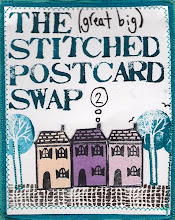
  The Great Big Stitched Postcard Swap is back by popular demand!  Sign up now and be part of the fun (not to mention the special giveaway...)

Monday, 20 September 2010

Do What You Love interview: Jessica Gonacha Swift

Today's Do What You Love interview is coming to you from Portsmouth, New Hampshire, where I am recovering from four awesome days at the Squam art retreat.  Artwork and photos to follow after I have processed the details of a very special experience. 

For now I want to share this interview with Jessica Gonacha Swift, a painter, surface pattern designer and illustrator based in Atlanta, Georgia.

 Image courtesy of Jessica Swift 

I was originally drawn to Jessica's gorgeous fabric designs but have just seen some of her original art work in the Enormous Tiny Art Show here at the Nahcotta Gallery in Portsmouth and they are just as juicy. Jessica is married and lives in Atlanta, Georgia with her two adorable cats. She has been a working artist since 2003, when she was 23 years old. Today she is sharing a peek into her creative life.


'King of the Mountain'
(Image courtesy of Jessica Swift) 

How did you get drawn to textiles and surface pattern design?
I've always been drawn to color and pattern, and when I taught myself to create repeat patterns, a whole new world opened up for me. My grandmother used to tell me that I should be a fabric designer (she was a quilter), so that idea was placed in my head early on, but I never knew how to make that happen. I didn't realize people actually made careers of surface design until I started reading blogs and learning about the industry, and as I learned about it I was hooked immediately!
A selection of fabrics from Jessica's gorgeous new range
(Image courtesy of Jessica Swift) 

How important has your art education been in shaping your career (or has it been shaped by other things)?
My career hasn't been shaped by my art education very much at all; I studied painting in college and not textile or surface design at all; everything I'm doing now is entirely self-taught! I love learning new skills, and I constantly strive to be better, grow, and learn from what's happening around me, so being part of the online community of creatives is really what's shaped my career the last few years.

Has anyone played a mentor role for you as you have grown your business? If so who, and what was their most important or valuable piece of advice?
I've never really had a mentor, but I'll never forget something that one of my favorite professors in college told me. He said "you have to be willing to make the bad work in order to make the good work." I always remember that when I create something that I don't think is very good-- I'm just making room for the good stuff!

'Jump'
(Image courtesy of Jessica Swift)

What single opportunity has been the greatest catalyst for the growth of your creative business and how did it come about?
I think exhibiting at my first trade show, Printsource, in January 2009 was a big catalyst for my business- it was the first time I took myself seriously as a surface designer and knew that I wanted to devote myself to it. I exhibited just 6 short months after I first learned to create patterns, and it was a huge leap of faith. I knew in my gut that I had to just jump in if I was going to make big things happen, so I went for it, even though it was scary! I learned about the show through an email from the director, inviting me to exhibit. It felt like a sign from the universe, because just a few days prior to that email I'd decided that I wanted to exhibit at a trade show but didn't know where or how to start. The email came and that was that!
(Note from Beth: Don't you just love those signs from the universe?)

'Hope'
(Image courtesy of Jessica Swift)

What do you wish you had known when you started?
I wish I would've known about surface design as a career when I first began down my path as a working artist (I primarily painted and sold my work at outdoor juried art festivals in the beginning). I wish someone would've led me toward commercial art when I started out, because I could've gotten an earlier start in my career in surface design-- it was instantly my obsessive passion when I discovered it, and I wonder where I might be now had I started 5 or 6 years earlier!

What is your big dream for your creative business? (Go on, put it out there!)
I want to be like Orla Kiely and Jonathan Adler! I want to have shops throughout the country and world full of products with my designs, and I want to create a fun, hip lifestyle brand. That's definitely the big dream.  (Note from Beth:  You heard it first here!  What a fantastic big dream)

'Let your worries fall away'
(Image courtesy of Jessica Swift) 

Check out Jessica's gorgeous work on her website or in her etsy shop.  You can also find her on Twitter and Facebook.  And watch this space for a very special giveaway coming soon in October, featuring some original creations made using Jessica's brand new line of fabric.

***
See here for more interviews with inspiring people doing what they love

Wednesday, 8 September 2010

Do What You Love interview: Tim Moss

(image courtesy of Tim Moss)

Do you love adventure like I do? How about skiing to the South Pole?  Tim Moss fancies a go at it, but unlike most people who just dream about it, he is actually going.  In January he will be accompanied on his 'Inspired by London 2012 South Pole Adventure' by an Olympian (Derek Redmond), a Paralympian (Marc Woods), and a Special Olympics athlete (Declan Kerry), as they ski to the bottom of the earth to wave the British flag in the name of participation, inclusivity and accessibility, and marking the 100th anniversary of Captain Scott reaching the Pole.

At university Tim decided on a whim to organise a mountaineering expedition to Kyrgyzstan, a country he'd never heard of. In his words, "It all went horribly wrong, I had a wonderful time and have been trying to have as many adventures as humanly possible ever since."

He now runs adventure consulting business The Next Challenge, helping others to live their adventures.  Tim is a guy who really does what he loves.

(image courtesy of David Tett)

1) What does 'adventure' mean to you? Adventure, to me, simply means trying something that's a bit different. Something you haven't done before, that maybe pushes or scares you a little bit and probably teaches you something about yourself.  I don't subscribe to the idea that adventure is synonymous with 'extreme' but rather think that it's available to anyone and that everyone could benefit from a little more of it in their lives,

2) What is the single most important thing for succeeding at the kind of challenges you take on? The single most important thing for succeeding at a challenge is starting. Start and the rest will follow.

3) Which has been your favourite so far? Why?  My favourite of recent times has been hitch-hiking around the UK on a budget of £100 (approx US$150). I caught myself thinking that I was too poor to go on an expedition when I got a cheque for Christmas that I cashed in for an adventure. I spent a lot of time freezing cold at the side of the road with my thumb out and sleeping in some pretty rough areas, but I also met some wonderfully generous people, made it as far as Dublin for a Guinness, swam in the sea off the Welsh coast and made it back with £30 change!

(image courtesy of David Tett)

4) And the toughest? What did you learn?  In Kyrgyzstan we found ourselves at the end of 5-day trek along a glacier, walking through snow in the dark with no food and the only sign of the base camp that was supposed to feed and shelter us, was a pile of ruined huts. We also slept bolt-upright on the tiny ledge of a 45-degree snow slope and two of us dangled from a rope attached only to our team-mate's waist on a vertical ice wall.

These were all self-inflicted problems from our total inexperience but they taught me that "It doesn't have to be fun to be fun" (Mark Twight) and, more importantly, it showed me that I was capable of a LOT more than I might previously have thought. I'm absolutely not special in any way but from being put into the great variety of situations that you find on an expedition, I drastically improved my self-belief.

5) What advice would you give to someone who would love to do something like this, but is telling themselves 'you don't have the time, money, connections, freedom from responsibilities etc etc'  I've tried to demonstrate through my own adventures that time, money and connections are not necessary - my £100 Adventure, Running the Tube challenge and London to Isle-ofWight triathlon all required very little of each.

If you really want to try something then there will be a way. It doesn't have to be cycling around the world or climbing Everest but you always fit a little bit of adventure in.  (And if it's really contacts that you're struggling with, maybe I can help?)

6) In your eyes, what is the ultimate challenge?
The ultimate challenge is the one that leaves you happy, sated and desperately wanting more.

***
Tim's South Pole challenge has been entered into British Airways' 'Great Briton' awards, and if he wins, the airline will provide free flights for the team's expedition.  You can help him on his way by voting for him here and follow his adventures here

***

See here for other inspiring interviews with people doing what they love
Related Posts with Thumbnails